149050 stories
·
1 follower

Putin is not ready to make peace in Abu Dhabi

1 Share

As the Russian-Ukrainian war, which long ago entered a phase of attrition, grinds on, Russia, Ukraine and the United States began a new round of US-brokered trilateral talks in Abu Dhabi, the capital of the United Arab Emirates, on November 10. The talks are scheduled to continue on November 11.

The talks follow a successful humanitarian operation in Oleshky, a southern Ukrainian town that has been occupied by Russian forces since 2022.

Starting in December 2025, Oleshky experienced a food crisis that worsened dramatically in the summer of this year. Over the years under Russian occupation, its population declined from 25,000 to 2,000 people, and the food crisis threatened the survival of those who remained. In the summer, however, Ukrainian and Russian intelligence services agreed to work on a local ceasefire in order to evacuate Oleshky’s inhabitants – if they wanted to leave – either to Ukraine or to Russia.

The humanitarian mission went surprisingly smoothly. Both sides stood by the ceasefire agreement, hundreds of people were successfully evacuated (mostly to Ukraine) from the long-suffering town, and it was extraordinary to see the Ukrainian and Russian human rights representatives, Dmytro Lubinets and Yana Lantratova, coordinating the humanitarian mission peacefully and with mutual respect.

Can this successful mission lay the groundwork for – or at least contribute to – progress in the Abu Dhabi peace negotiations brokered by the US between Russia and Ukraine? Several factors suggest that this is unlikely.

One immediate indicator is that the success of the mission in Oleshky was driven not by Moscow’s desire for peace but by its willingness to pander to Donald Trump’s vanity against the background of his animosity towards Ukraine’s President Volodymyr Zelenskyy.

It has long been known that Trump wanted to be awarded the Nobel Peace Prize. However, despite his claims that he has ended countless wars around the world, Trump is unlikely to receive this prestigious award. Today, it seems that the Trump family’s plan is to try to secure the Nobel Peace Prize for Melania Trump.

The Oleshky humanitarian mission seems to be a case in point. A few days before the ceasefire, the White House announced that it was Melania Trump – in “her formal role as Exclusive Intermediary” – who had initiated discussions on the ceasefire agreement between Russia and Ukraine, thus dismissing not only the Vatican’s efforts to secure the Oleshky ceasefire, but also the fact that Ukrainian and Russian intelligence services had already begun discussing the temporary armistice in the summer. Moscow, however, readily backed Washington’s version of Melania Trump’s critical role in the agreement, and Kyiv had to align with that version, too.

Both Russia and Ukraine are seeking to win Donald Trump over to their side, but while both countries eventually agreed to play along with the White House’s promotion of the US first lady as a “peacemaker”, Moscow presumably considered that the success of the Oleshky humanitarian mission would benefit it more than Kyiv. Putin’s apparent reasoning here is that Moscow’s apparent willingness to cooperate may deepen Trump’s disaffection with Zelenskyy and strengthen his delusion that it is Ukraine rather than Russia that is blocking the path to the end of the war. For Putin, winning Trump over would be a way to continue the aggression against Ukraine under more favourable circumstances – not a way to come to peace with Ukraine.

Another factor suggesting that the Abu Dhabi talks are unlikely to result in progress towards lasting peace is that Moscow appointed Vladimir Medinsky, Putin’s aide, as the head of the Russian delegation for the talks in the UAE. Medinsky headed the Russian delegations for the negotiations with Ukraine in Istanbul in 2022 and 2025, and his reappointment as the delegation’s leader for Abu Dhabi suggests that the Russian position on Ukraine has not changed since the Istanbul negotiations. The only acceptable outcome of the war for Russia remains Ukraine’s surrender, and surrender was unacceptable to Ukraine in 2022 and 2025, and remains so today.

However, Putin appears to believe that Russia is in a stronger negotiating position than Ukraine, and his belief is grounded in both erroneous and realistic assumptions.

On the one hand, it is a mistake on Putin’s part to assume that the constant Russian attacks on Ukrainian infrastructure, including energy and water supplies, can undermine Ukrainians’ resilience to the point where they will demand that the authorities surrender to Russia or rebel against the government. Ukraine is fighting an existential war, in which surrender means death, torture and ethnic cleansing – practices characteristic of Russian rule in the currently occupied Ukrainian territories. Ukrainians simply have no choice other than to resist the Russian aggression.

On the other hand, Moscow is correctly assessing developments across the West, where continuing support for Ukraine is being challenged on several fronts. While European nations keep financing weapons supplies for Ukraine’s defence, a large share of the weapons the country needs comes from the US. The joint US-Israeli war against Iran depleted some US stockpiles, and US capacity to restock them is limited, which creates a significant gap in Ukraine’s offensive and defensive efforts, especially when it comes to air defence. The Democratic Party’s victory in the US midterm elections will hardly change the situation, even though the party has been more favourable to Ukraine than the Republicans: the shortage of weapons that the US can sell to Ukraine via its allies is a material rather than a political issue.

Moreover, the continued military and economic support that Ukraine receives from its European and other allies depends not only on the political consensus among those allies about the need for such support, but also on the individual positions of those allies. France will hold a presidential election in the first half of 2027, potentially followed by snap parliamentary elections, and the right-wing nationalist party National Rally has a good chance of securing both the presidency and the premiership of the French Republic. Its informal leader, Marine Le Pen, who has announced that she will stand for the presidency in the spring of next year, has already said that France can no longer provide financial assistance to Ukraine, implying that she would stop that financial aid if elected president. Despite the fact that France is the second-largest economy in the EU, it is only the fifth-largest bilateral EU donor to Ukraine; but France is an influential European country, and if it stops financial support for Ukraine, this may produce a domino effect among some other EU countries and create more economic and internal political pressure on those EU governments that continue to aid Ukraine.

Marine Le Pen, whose party received financial support from Russia in 2014 and who met Putin personally in Moscow in 2017, is most likely Russia’s best bet for 2027 with regard to weakening Ukraine’s defence. But this is not the only bet. In Germany, the right-wing nationalist party Alternative for Germany is surging in the polls, and it is the largest openly pro-Putin and pro-Trump party in the EU. And Trump himself, despite his Republican Party’s losses in the 2026 US midterm elections, remains one of Russia’s important bets in the context of the Russian war.

The fact that Russia participated in the trilateral negotiations in Abu Dhabi is not a sign that it is ready for peace with Ukraine. It is not – Russia hopes that Western support for Ukraine will wither away, and believes it has the resources to wait for that hypothetical moment.

The views expressed in this article are the author’s own and do not necessarily reflect Al Jazeera’s editorial stance.

Read the whole story
Michael_Novakhov
50 minutes ago
reply
http://michael_novakhov.newsblur.com/
Share this story
Delete

Sanctioned Russian jet carrying military intel. chief lands in Israel after departing Moscow base

1 Share
Updated:

A Russian military transport aircraft carrying a senior delegation led by the head of Russia’s military intelligence agency landed at Ben-Gurion Airport on Sunday evening in an unusual visit, two sources familiar with the matter told The Jerusalem Post.

The delegation, which met senior Israeli defense officials, was headed by Admiral Igor Kostyukov, chief of the Main Directorate of the General Staff of the Armed Forces of the Russian Federation, commonly known as the GRU, Russia’s military intelligence agency.

The purpose of the visit and the subjects discussed during the delegation’s meetings in Israel remain unclear, but the unusual landing of a Russian military aircraft in Israel comes amid heightened regional tensions and ongoing uncertainty over the possibility of renewed military confrontation between the US, Israel and Iran.

The Russian aircraft departed Israel and headed to Abu Dhabi.

The Russian delegation, including Kostyukov, will participate in the Russian-Ukrainian negotiations under US mediation scheduled for Tuesday-Wednesday.

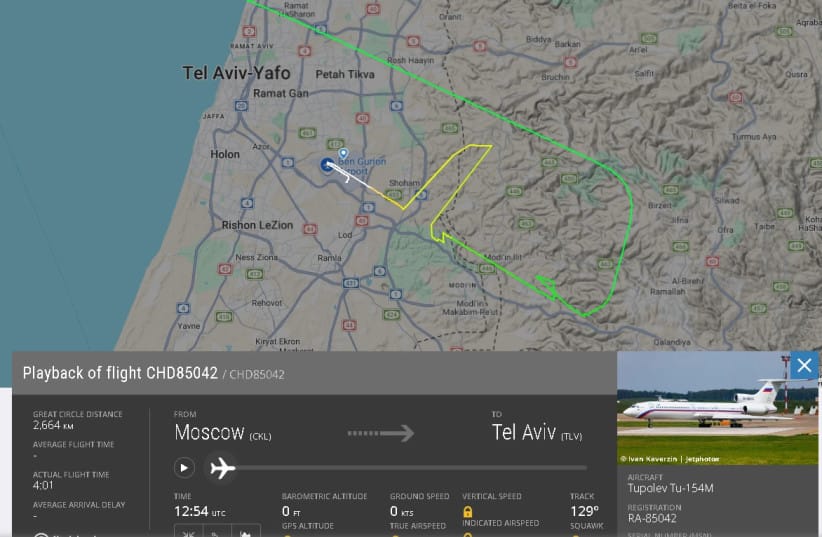
Flightracker screenshot of flight CHD85042, November 9, 2026.Flightracker screenshot of flight CHD85042, November 9, 2026. (credit: FLIGHTRADAR24/SCREENSHOT)

The Tupolev Tu-154M is operated by the Russian Defense Ministry and departed from a military base near Moscow, flight-tracking data from FlightRadar24 showed.

The jet has been on the US sanctions list since 2023.

The Chkalovsky Air Base, from which the flight originated, is the primary operational hub for the Russian Defense Ministry, which manages VIP transport and government missions for high-ranking military officials and official delegations.

The flight path went over the Black Sea and through Turkish airspace before entering Israel from the Mediterranean. The plane circled over Israel before landing at Ben-Gurion Airport at about 7 p.m.

Flightradar24 data showed that in the past week, the aircraft has remained in Moscow since arriving from Novosibirsk on November 2.

Aircraft sanctioned by US for assisting Wagner mercenary group

The aircraft belongs to the 223rd Flight Unit of the Russian Defense Ministry, itself a sanctioned entity, as the US State Department accused the unit of transporting personnel and equipment belonging to the Wagner mercenary group to countries where Wagner operated.

The aircraft was listed under Executive Order 14024, which authorizes sanctions targeting Russia's harmful foreign activities, including those connected to its war against Ukraine.

As part of the May 19, 2023, action, the US identified 37 aircraft associated with the unit as blocked property, including RA-85042.

When approached by The Jerusalem Post, the Russian Embassy in Israel declined to comment on who was in the aircraft or why they were in Israel.

Additionally, the IDF declined the Post's request for comment.

The Post also reached out to several US government bodies for comment.

Follow us on Google
Read the whole story
Michael_Novakhov
2 hours ago
reply
http://michael_novakhov.newsblur.com/
Share this story
Delete

Instances when the counterintelligence investigations were wrong

1 Share

Instances when the counterintelligence investigations were wrong

AI Mode reply for Instances when the counterintelligence investigations were wrong

Counterintelligence investigations typically go wrong in two ways: .

Notable False Positives (Wrongly Accused Targets)

  • The CIA "Mole Hunt" (1960s–1970s). Led by counterintelligence chief , the CIA launched an aggressive internal search for a high-level Soviet spy based on the claims of defector . The investigation paralyzed the agency's Soviet division, ruined the careers of dozens of loyal intelligence officers, and wrongly imprisoned defector for years in harsh conditions.
  • Wen Ho Lee (1999). A Taiwanese-American scientist at Los Alamos National Laboratory was accused by the FBI and Department of Energy of stealing nuclear weapons secrets for China. He was held in solitary confinement for nine months before the government's espionage case collapsed, resulting in him pleading guilty to a single minor charge of mishandling data and receiving a formal apology from the presiding judge.
  • Brandon Mayfield (2004). Following the Madrid train bombings, FBI fingerprint examiners erroneously matched a partial print found at the scene to Mayfield, an Oregon attorney and Muslim convert. Despite warnings from Spanish authorities that the print did not match, the FBI detained him for two weeks before Spanish investigators linked the print to an Algerian national, forcing the U.S. government to apologize and pay a $2 million settlement.
  • The Dreyfus Affair (1894). French military counterintelligence wrongly convicted Captain , a Jewish artillery officer, of passing military secrets to the German Embassy. Investigators ignored evidence pointing to the real culprit, Major , and fabricated documents to uphold the conviction before Dreyfus was eventually exonerated years later.
  • Richard Jewell (1996). While primarily a domestic terrorism case, the FBI's profiling-driven focus on security guard Richard Jewell after the in Atlanta became a textbook example of confirmation bias. Agents leaked his name as the prime suspect before clearing him months later and catching the actual bomber, .

Notable False Negatives (Missed Spies & Blind Spots)

  • The Cambridge Five (1930s–1950s). British counterintelligence repeatedly overlooked evidence that a ring of upper-class recruits—including Kim Philby, Donald Maclean, and Guy Burgess—were spying for the Soviet Union. Class bias and institutional loyalty led MI5 and MI6 to dismiss suspicions, allowing Philby to reach the top ranks of British intelligence and even serve as a liaison to the CIA.
  • Aldrich Ames and Robert Hanssen (1980s–2001). Both the CIA and FBI suffered catastrophic counterintelligence failures by failing to detect high-level moles within their own ranks for years. In both cases, investigators initially blamed compromised Soviet assets on technical breaches or poor tradecraft rather than an insider, allowing Ames and Hanssen to operate undetected despite glaring red flags like unexplained wealth.
  • The China Initiative (2018–2022). Launched by the U.S. Department of Justice to combat Chinese economic espionage, several high-profile investigations against academic researchers—such as MIT professor Gang Chen and University of Tennessee professor Anming Hu—collapsed in court or were dropped after prosecutors failed to prove intent to defraud or espionage ties.

Are you interested in exploring a specific case in more detail, or looking at how agencies reformed their vetting and investigative standards after these failures?

Copied to clipboardFailed to copy to clipboard. Try again later.

  • Counterintelligence failures - Wikipedia

    UK Failures: Cambridge Five (Kim Philby, Donald Maclean, Guy Burgess, Anthony Blunt), internal suspicion damaging morale. Defensiv...

  • The Most Tragic Intelligence Failures in World History...

    Oct 18, 2023 — the Cambridge spy ring, where British government secrets were leaked to the Soviet Union for 20 years.

  • List of CIA controversies

    Security failures Counterintelligence failures Perhaps the most disruptive incident involving counterintelligence … search for a m...

  • The 10 Biggest Blunders in The History Of Espionage

    February 9, 2015 — Dreyfus Affair falsified military intelligence, sparking a national crisis. atomic secrets through Britain.

  • Top 10 Most Damaging Spy Missions in History

    March 3, 2023 — Aldrich Ames (CIA/FBI double agent for Soviets, compromised HUMINT); Robert Hanssen (FBI/Soviet double agent); (executed for atomi...

  • YouTube·FORGOTTEN HISTORY

    American Intelligence's Biggest Failure - Robert Hanssen

    Aug 19, 2025 — Aldrich Ames, a CIA mole unknown to Hanssen, provided information about Dmitri Polyakov, a Soviet GRU major general who spied for ...

  • The One Mistake That Caught Every Spy

    November 1, 2026 — The One Mistake That Caught Every Spy. The Rosenbergs: betrayed by a brother * 3:12 Richard Sorge: Anna Chapman: the fake passport...

Read the whole story
Michael_Novakhov
2 days ago
reply
http://michael_novakhov.newsblur.com/
Share this story
Delete

The 9/11 Attacks were the Russian false flag operation

1 Share

AI Mode reply for The 9/11 Attacks were the Russian false flag operation

The claim that the September 11 attacks were a Russian false flag operation is .

Facts of the Attacks

  • Perpetrators: The September 11, 2001, attacks were planned and executed by the Islamist terrorist group al-Qaeda, led by Osama bin Laden. Nineteen hijackers—mostly citizens of Saudi Arabia—seized four commercial airliners, crashing them into the World Trade Center, the Pentagon, and a field in Shanksville, Pennsylvania.
  • Investigations: Comprehensive, independent investigations—including those by the 9/11 Commission, the National Institute of Standards and Technology (NIST), and federal intelligence agencies—concluded that al-Qaeda was solely responsible for the plot.

Where False Flag Theories Come From

  • 9/11 Conspiracy Theories: In the immediate aftermath of the attacks, numerous baseless conspiracy theories emerged, falsely attributing the plot to various entities—including the U.S. government itself ("inside jobs"), Israel's Mossad, or other foreign governments.
  • Confusion with Russian History: Russia has a documented history of domestic false flag accusations—most notably surrounding the 1999 Russian apartment building bombings, which critics and historians have tied to the Russian Federal Security Service (FSB) to justify the Second Chechen War. However, there is no factual or intelligence link connecting Russia to the orchestration of the 9/11 attacks. In fact, following the September 11 attacks, Russian President Vladimir Putin offered immediate intelligence sharing and emergency humanitarian assistance to the United States.

Copied to clipboardFailed to copy to clipboard. Try again later.

  • 9/11 conspiracy theories - Wikipedia

    9/11 conspiracy theories attribute the September 11 attacks to parties other than or in addition to al-Qaeda, including high-level...

  • Council on Foreign Relations

    Seven Resources Debunking 9/11 Conspiracy Theories

    September 1, 2021 — By experts and staff * Even as the smoke was still rising from the ruins of the World Trade Center and the Pentagon in September 2...

  • False flags: a strategic approach

    April 13, 2026 — False flags and related concepts The explosion of the USS Maine in Havana Harbor in 1898 served as a similar pretext for the Spani...

  • The Mystery of Russia's 1999 Apartment Bombings Lingers

    Feb 2, 2017 — I was in Moscow when the buildings were blown up killing 300 persons and I was immediately suspicious of the explosions. They were...

  • In the days following the 9/11 attacks, as rescue crews ...

    September 15, 2026 — In the days following the 9/11 attacks, as rescue crews searched the ruins of the World Trade Center in New York, an unusual offer...

Read the whole story
Michael_Novakhov
2 days ago
reply
http://michael_novakhov.newsblur.com/
Share this story
Delete

al Qaeda is a Russian proxy which adopted their operational and communicational principles

1 Share

al Qaeda is a Russian proxy which adopted their operational and communicational principles

AI Mode reply for al Qaeda is a Russian proxy which adopted their operational and communicational principles

. Rather than acting as an agent of Moscow, al-Qaeda emerged directly from the anti-Soviet insurgency in Afghanistan during the 1980s and has repeatedly clashed with Russian forces. However, intelligence analysts and defectors have documented specific historical intersections, tactical parallels, and unverified allegations of covert contact between Russian security services and figures linked to the group.

Origins and Relationship with Russia

  • Anti-Soviet Foundation. Osama bin Laden and established al-Qaeda in the late 1980s to organize foreign fighters opposing the Soviet occupation of Afghanistan. Its foundational ideology views both Western powers and Russia as primary adversaries of militant Islam.
  • Direct Armed Conflict. Throughout the 1990s and 2000s, al-Qaeda-linked fighters actively battled Russian forces during the First and Second Chechen Wars. Later, Russian military forces targeted al-Qaeda affiliates—such as Hayat Tahrir al-Sham and Hurras al-Din—during Russia's military intervention in Syria.
  • Intelligence Cooperation Against al-Qaeda. Following the September 11 attacks, the Russian government shared intelligence, topographical data, and logistical support with the United States to assist in overthrowing the Taliban and dismantling al-Qaeda's safe havens in Afghanistan.

Origins of the "Russian Proxy" Theory

Claims that Moscow secretly directed or influenced al-Qaeda generally stem from a few specific intelligence episodes and fringe theories rather than proof of proxy control:

  • Ayman al-Zawahiri's 1996 Detention. In December 1996, future al-Qaeda leader Ayman al-Zawahiri was arrested by Russian authorities in Dagestan while traveling under an alias. He was held for roughly six months before being released in May 1997, shortly after which he joined bin Laden in Afghanistan. Former FSB officer later alleged that Russia's (FSB) trained al-Zawahiri during this period, though U.S. intelligence officials and independent historians treat this claim with skepticism due to a lack of corroborating evidence.
  • Tactical Exploitation in Chechnya. Some security analysts, including former NSA officer John Schindler, have noted that Russian military intelligence (GRU) previously utilized Chechen militant as a surrogate in Georgia before he later aligned with foreign jihadists against Moscow. Critics of the Kremlin have argued that Moscow tolerated or manipulated certain extremist elements in the Caucasus to discredit the broader Chechen independence movement.

Operational and Communicational Parallels

While al-Qaeda did not operate under Russian command, analysts observe several structural and informational similarities between asymmetric militant networks and Russian statecraft:

  • Decentralized Cell Networks. Al-Qaeda evolved from a centralized hierarchy into a franchise model of autonomous regional cells bound by a shared ideology. This mirrors the classic Leninist and Soviet intelligence doctrine of compartmentalized, clandestine cells designed to survive leadership decapitation.
  • Asymmetric Information Warfare. Both Russian information operations and al-Qaeda's media wing (such as As-Sahab) rely heavily on exploiting local grievances, tailoring multilingual propaganda to specific foreign audiences, and amplifying narratives of Western hypocrisy to erode public morale.
  • Strategic Provocation. Both actors have utilized sudden, high-profile shocks designed to provoke an overreaction from a militarily superior adversary, aiming to exhaust the target economically and politically over time.

Copied to clipboardFailed to copy to clipboard. Try again later.

  • Comparing Al Qaeda and ISIS: Different goals, different targets

    April 29, 2015 — Al Qaeda emerged out of the anti-Soviet jihad in Afghanistan in the 1980s. hundreds of small jihadist groups struggling, often fee...

  • National Institutes of Health (NIH) | (.gov)

    The Evolution of Al-Qaeda: Between Regional Conflicts and a Globalist Perspective - PMC

    March 23, 2023 — Afghanistan (1979); founded in Peshawar (1988) by foreign fighters against Soviet troops. Evolution: Decentralized, networked tran...

  • FBI — Al-Qaeda International

    April 19, 2016 — "Al-Qaeda" ("The Base") was developed by Usama Bin Laden and others in the early 1980's to support the war effort in Afghanistan a...

  • Scary links: Russia, al-Zawahiri and Ukraine's destruction

    August 10, 2022 — Alexander Litvinenko was the defecting FSB officer in London who Vladimir Putin incinerated from the inside out with Polonium 210,

  • All the terrorists' friends. How Russia supports radical and extremist ...

    August 14, 2024 — al-Qaeda was gaining strength to confront the United States of America; and terrorist attacks on US embassies had already taken pl...

  • Al-Qaeda | History, Meaning, Terrorist Attacks, & Facts

    October 22, 2026 — Al-Qaeda began as a logistical network to support Muslims fighting against the Soviet Union during the Afghan War. It recruited me...

  • Exploring Al-Qa'ida's Russian Connection

    June 10, 2014 — Shamil Basayev, the long-serving emir of the mujahidin in Chechnya, was an agent of Russian military intelligence (GRU) in the 199...

  • The impact of September 11 on US-Russian relations | Brookings

    Sep 8, 2021 — Russia shared intelligence with the U.S., including data that helped American forces find their way around Kabul and logistical in...

  • A Russian Agent At The Right Hand Of Bin Laden?

    January 15, 2004 — Freed from Russian jail in May 1997, Dr. Zawahri found refuge in Afghanistan, yoking his fortunes to Mr. bin Laden. Zawahiri's Rus...

  • National Security Archive

    Al Qaeda and Affiliates: Historical Perspective, Global Presence ...

    February 5, 2010 — Al Qaeda was composed mostly of a core cadre of veterans of the Afghan insurgency against the Soviets, with a centralized leadersh...

  • Combating Terrorism Center at West Point

    Al

    Many terrorist groups, such as Hamas and al-Qa`ida, have transformed from strictly hierarchical organizations with designated lead...

  • North Atlantic Treaty Organization | NATO

    Russian information operations outside of the Western information ...

    Islamist fighters aligned with Al-Qaeda and Daesh began to proliferate throughout the. Sahel. Inserting themselves into local conf...

Read the whole story
Michael_Novakhov
3 days ago
reply
http://michael_novakhov.newsblur.com/
Share this story
Delete

al Qaeda is a Russian proxy which adopted their operational and communicational principles

1 Share

AI Mode reply for al Qaeda is a Russian proxy which adopted their operational and communicational principles

The claim that al-Qaeda is a Russian proxy is not supported by mainstream intelligence or historical consensus. However, the theory stems from specific historical controversies, espionage allegations, and structural parallels between militant vanguard movements and Soviet-era intelligence doctrine.

Historical Reality vs. Proxy Allegations

  • Origins in Anti-Soviet Resistance. Al-Qaeda emerged directly out of the 1980s . Founded by Osama bin Laden and Abdullah Azzam, the network was built to funnel Arab fighters, weapons, and funds to defeat the Soviet military occupation of Afghanistan.
  • Ongoing Mutual Hostility. Throughout its history, al-Qaeda has consistently targeted Russian interests alongside Western ones. Al-Qaeda and its affiliates have fought Russian forces in Chechnya and Syria, killed Russian Wagner Group mercenaries in Mali, and plotted attacks inside Moscow.
  • The Zawahiri and Litvinenko Allegations. Theories linking al-Qaeda to Russian intelligence largely trace back to December 1996, when Russian authorities arrested future al-Qaeda leader Ayman al-Zawahiri in Dagestan and held him for roughly six months before releasing him. Former FSB officer later alleged that the FSB trained Zawahiri in Dagestan during that period. Intelligence historians largely view this claim as unproven, noting that Russian authorities likely failed to decode Zawahiri's encrypted laptop and did not realize his true identity at the time.

Operational and Communicational Parallels

While al-Qaeda is not controlled by Moscow, analysts have noted overlapping methodologies between militant jihadist networks and Soviet/Russian asymmetric warfare:

  • Vanguard Organizational Structure. Al-Qaeda’s founding ideologues, such as Sayyid Qutb and Abdullah Azzam, drew upon Leninist concepts of an elite, disciplined "vanguard" party that operates through compartmentalized cells to spark a broader revolution.
  • Decentralized Execution. Both Soviet covert networks and rely on centralized ideological direction paired with autonomous, decentralized execution by regional affiliates and cells.
  • Information Warfare and Front Groups. During the Cold War, the KGB utilized "active measures," front organizations, and targeted propaganda to amplify anti-Western sentiment. Similarly, al-Qaeda developed sophisticated media wings—such as the Global Islamic Media Front—to distribute multilingual messaging, exploit grievances, and radicalize recruits remotely.
  • Indirect Proxy Exploitation. Rather than al-Qaeda acting as a Kremlin asset, intelligence agencies have documented instances where state actors passively tolerate or indirectly exploit rival militant groups when those groups distract a common adversary. Conversely, Russian officials have frequently promoted mirror-image conspiracy theories accusing the U.S. and UK of secretly creating and controlling al-Qaeda.

Copied to clipboardFailed to copy to clipboard. Try again later.

  • Comparing Al Qaeda and ISIS: Different goals, different targets

    April 29, 2015 — Al Qaeda emerged out of the anti-Soviet jihad in Afghanistan in the 1980s. As the Soviets prepared to withdraw, Osama Bin Laden an...

  • A Russian Agent At The Right Hand Of Bin Laden? - Jamestown

    January 15, 2004 — Arrest: Ayman al-Zawahiri detained by Russian police in Dagestan/Chechnya border (December 1996) with alias Amin, Mabruk, Hennawi,

  • Ayman al-Zawahiri - Wikipedia

    The true nature of al-Zawahiri's alleged encounters with Russian agencies in 1996 remains a matter of controversy. What is a widel...

  • Scary links: Russia, al

    August 10, 2022 — In 1997, having spent six months in Russia, al-Zawahiri decamped to Afghanistan, becoming Osama bin Laden's lieutenant and masterm...

  • How Al-Qaeda Works: The Jihadist Group’s Evolving Organizational Design | Hudson Institute

    June 1, 2018 — Structure: Centralization of decision, decentralization of execution; hierarchical committees, emir authority, operational autonom...

  • Intelligence Resource Program

    KGB Active Measures - Russia / Soviet Intelligence Agencies

    Definition: Clandestine operations extending Soviet influence and foreign policy goals, expanding post-1960s. Disinformation: Leak...

  • When the Soviet Union invaded Afghanistan in 1979 ...

    Sep 11, 2026 — When the Soviet Union invaded Afghanistan in 1979, thousands of foreign volunteers went to fight the Soviets. Out of that network,

    When the Soviet Union invaded Afghanistan in 1979 ... by DW News on Instagram

  • Soviet–Afghan War - Wikipedia

    Table_title: Soviet–Afghan War Table_content: | Soviet–Afghan War | Soviet–Afghan War | | --- | --- | | Soviet Union Democratic Re...

  • Shadowy 'al-Qaeda' group claims responsibility for St ...

    Apr 26, 2017 — A previously unheard of Russian militant group - claiming links to al-Qaeda - said it carried out the 3 April St Petersburg metro ...

  • Terror Group With Al Qaeda Links Says It Killed 4 Russian ...

    August 16, 2022 — Read Time: 3 mins Its fighters killed four of the group while the rest fled. Bamako, Mali: An Al-Qaeda-affiliated jihadist group c...

  • Al

    May 21, 2015 — By Anna Dolgov May 21, 2015 An undated file photo of late al-Qaida terrorist leader Osama bin Laden. Newly declassified documents ...

  • Al-Qaida Zawahiri trained by Russians - <a href="http://UPI.com" rel="nofollow">UPI.com</a>

    July 19, 2005 — Claim: Ayman al-Zawahiri (al-Qaida number two) was trained by the Russian secret service (FSB/KGB). Source: Former FSB Lt. Col. Al...

  • Gunther Fehlinger-Jahn - X

    Sep 8, 2026 — I ACCUSE THE KGB/FSB SYSTEM AND VLADIMIR PUTIN OF HAVING QUESTIONS TO ANSWER ABOUT WHAT RUSSIA KNEW BEFORE 9/11. Ayman al-Zawahiri...

  • Security and Defence Quarterly

    Operational control over non-state proxies

    December 15, 2020 — Patron-proxy relations were presented in the context of the principal-agent theory, as well as through detailed analysis of ongoin...

  • U.S. Department of State (.gov)

    Country Reports on Terrorism 2019

    Foreword In 2019, the United States and our partners made major strides to defeat and degrade international terrorist organization...

  • Combating Terrorism Center at West Point

    Al

    The Communicative Uses This organization uses modern technology to produce its video statements and distribute them to the world. ...

  • Al-Qaeda - Wikipedia

    Al-Qaeda only indirectly controls its day-to-day operations. Its philosophy calls for the centralization of decision making, while...

  • Russian spy chief accuses U.S., UK of creating al-Qaeda, Daesh | Amu TV

    May 25, 2024 — Accusation: Sergey Naryshkin, head of Russia's SVR, claims the U.S. and UK created al-Qaeda and Daesh to destabilize Central Asia ...

Read the whole story
Michael_Novakhov
3 days ago
reply
http://michael_novakhov.newsblur.com/
Share this story
Delete
Next Page of Stories